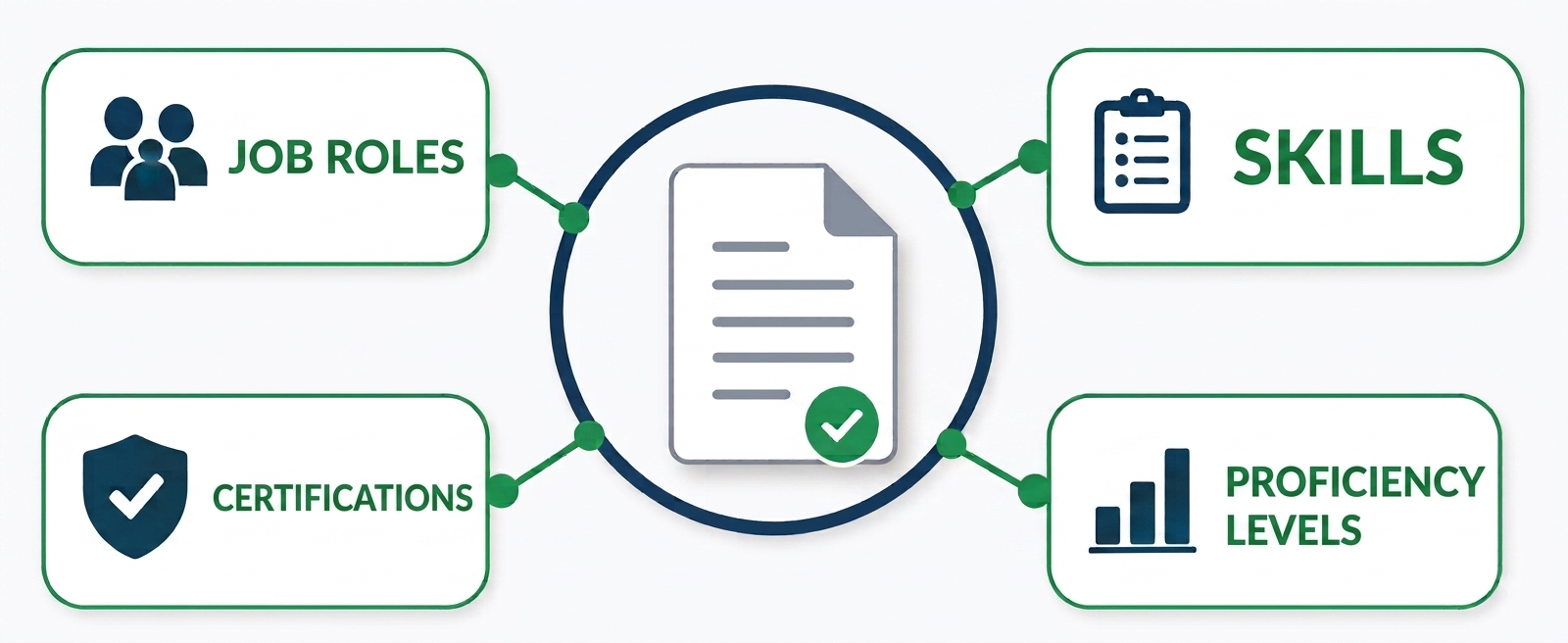
Today, HR leaders face major operational challenges: securing regulatory compliance, ensuring reliable recruitment, guaranteeing fair performance evaluations, and building genuinely impactful training plans. To address these interconnected demands, one priority is essential: having a clear, unified, and updated view of the company’s operational skills and legal compliance requirements.
This is precisely the role of a Skills and Mandatory Certifications Framework.
Far from being a mere administrative document, this mapping foundation serves as the backbone of your organization. It structures your decision-making, aligns business strategy with field reality, and elevates your HR governance to a strategic level.
Let’s explore how this tool transforms every step of your HR processes—and how to leverage it effectively.
- Skill vs. Mandatory Certification, What's the Difference?
- What is a Skills and Mandatory Certifications Framework
- The Impact of the Framework on Key HR Processes
- How to Build an Effective HR Framework
- Leveraging Artificial Intelligence in HR Engineering
- The AI-Powered Competency & Certification Framework Builder
Skill vs. Mandatory Certification, What’s the Difference?
Before building a skill matrix, it is crucial to clarify terminology. Skills and mandatory certifications / licenses are frequently confused, even though their nature, lifespan, and evaluation methods are fundamentally distinct.
What is a Skill?
A skill is a sustainable operational capability that can be observed and measured in a real working environment. It is neither a one-off task nor a simple personality trait.
- Evaluation: Assessed internally on the job using observable behaviors and activity metrics. Evaluations must occur regularly (e.g., during annual reviews or project milestones) to track proficiency growth over time.
- Scale: Typically measured on a continuous proficiency scale:
- Beginner / Novice
- Autonomous / Intermediate
- Proficient / Advanced
- Expert
Concrete Example, the skill “WMS / Inventory Data Analysis”:
- Warehouse Operator (Level 2 – Autonomous): Uses the mobile WMS application to receive goods, scan inventory, and resolve routine discrepancy errors during order picking.
- Data Analyst (Level 4 – Expert): Queries WMS and ERP databases using SQL, builds complex Power BI inventory models, identifies systemic supply chain bottlenecks, and designs predictive inventory workflows.
What is a Mandatory License / Certification?
A license or regulatory certification is a formal, mandatory authorization granted for a limited period. It guarantees that an employee possesses the required safety qualifications to perform tasks involving specific occupational or regulatory risks.
- Evaluation: Unlike a standard skill, a certification is audited or issued by an external accredited body or certified authority.
- Status: Binary (held or not held) with a strict expiration date requiring mandatory periodic renewals.
Examples of Mandatory Certifications & Regulatory Requirements:
- Forklift Certification (OSHA / Local License): Required for a Warehouse Supervisor or operator maneuvering powered industrial trucks.
- GDPR / Customer Data Compliance Awareness: Mandatory for Customer Service Agents handling sensitive customer data and AI-driven support platforms.
- ISO 27001 Security Training: Obligatory compliance requirement for the Cybersecurity Specialist and IT staff ahead of official audits.
What is a Skills and Mandatory Certifications Framework
A Skills and Mandatory Certifications Framework serves as the central map of a company’s operational know-how and legal compliance mandates.
It is a structured foundation that links each job role with:
- Required competencies and expected proficiency levels (from Beginner to Expert).
- Legal obligations and mandatory regulatory certifications to acquire or renew.
By interconnecting job profiles with industry standards and executive strategic goals, this master document goes far beyond a static administrative list. It operates as a dynamic functional tool supporting the entire HR value chain—from talent acquisition and performance evaluation to training and continuous compliance.
The Impact of the Framework on Key HR Processes
By linking each job role to its required skills, expected proficiency levels, and legal obligations, the framework centralizes and aligns all of the company’s human capital.
A. Compliance and Safety (Priority 1)
An expired forklift license in the warehouse or a GDPR breach in customer service directly exposes executive leadership to legal liability, operational disruption, and financial penalties. The framework locks down these risks by tying legal requirements directly to job roles.
Framework Value:
- Automatic mapping of every job position to its statutory certification obligations.
- Automated tracking and alerts for renewal deadlines to prevent compliance gaps.
- Mitigation of legal risks, workplace safety violations, and insurance invalidation.
- Centralized audit trails to streamline ISO and regulatory compliance audits.
B. Recruitment: Setting the Right Requirements
Without updated benchmarks, hiring relies on outdated job descriptions or gut feelings, risking over- or under-specifying candidate requirements.
Framework Value:
- Clear job profiles grounded in actual required competencies.
- Reduced hiring bias through structured interview criteria.
- Standardized candidate scoring rubrics.
- Targeted onboarding pathways aligned with day-one skill expectations.
For example, requiring advanced SQL programming for an entry-level Customer Service Agent creates unnecessary hiring friction when empathy and CRM proficiency are the actual performance drivers.
C. Performance Evaluation: Ensuring Fairness
Without standardized benchmarks, two managers may evaluate the same capability inconsistently, leading to perceived unfairness.
Framework Value:
- Replaces subjective opinions with observable behavior on the job.
- Unified 1-to-4 proficiency scale applied across all departments.
- Explicit criteria defining what is required to move from one level to the next.
- Objective foundation for constructive annual performance reviews.
For instance, regarding the skill “AI Prompt Engineering & Generative Content”: a Level 1 Content Marketing Specialist uses basic prompts for draft ideas, whereas a Level 4 Specialist engineers custom workflows, fine-tunes brand-specific templates, and trains team members.
D. Training & Development Planning
The framework converts the training plan into a targeted investment strategy through systematic Skill Gap Analysis.
- Who to Train?: Employees whose specific job roles demand a given skill or mandatory certification.
- Why Train?:
- Skills: An identified gap between current proficiency and target job requirements.
- Certifications: Upcoming license expiration, mandatory renewal cycles, or onboarding onto a regulated role.
- What Target?:
- Skills: Reaching a defined proficiency level (e.g., Level 2 to Level 3).
- Certifications: Successfully earning or renewing official compliance status.
How to Build an Effective HR Framework
An effective skill framework must be built directly from operational reality and business strategy—not designed theoretically in an isolated office.
The 4 Input Pillars
To model a relevant framework, four real-world data sources must be cross-referenced:
- Operational Activities: Analysis of actual jobs, daily tasks, and real workflows observed directly on the ground.
- Regulatory Standards & Norms: Legal obligations, safety mandates, industry certifications, and compliance standards (e.g., ISO standards, labor regulations, data privacy laws).
- Strategy & Business Goals: Alignment with executive vision, corporate priorities, and long-term business objectives.
- Transformation Projects: Organizational evolutions, technology implementations, new regulatory shifts, and process automation initiatives
Leveraging Artificial Intelligence in HR Engineering
Drafting, standardizing, and mapping a skill framework for dozens of job titles traditionally requires months of manual effort. This is where AI delivers immense speed and structural precision.
The Role of a Senior HR Architect
AI models can analyze operational data, digest complex job descriptions, resolve semantic redundancies, and map structured skill and certification blocks in seconds. It operates as an expert assistant for HR teams.
The AI-Powered Competency & Certification Framework Builder
A pragmatic approach combines the structure and reliability of a universal tool like Excel with the semantic analytical power of AI:
- No Complex SaaS Required: The tool organizes and structures your source data directly within Excel locally.
- Local Prompt Generation: Excel generates a tailored, privacy-safe prompt file formatted for the AI model of your choice.
- Turnkey HR Output: The AI processes the prompt and drafts a fully structured, operational framework ready to power recruitment, appraisals, and training plans.
- Human-in-the-Loop Governance: The final report includes a mandatory human validation clause, ensuring responsible and ethical AI adoption in HR decision-making.
👉 Get the AI-Powered Competency & Certification Framework Builder
Powered by AI – Nisrine LAHRECHE: Idea, Structure, Prompts, and Revision